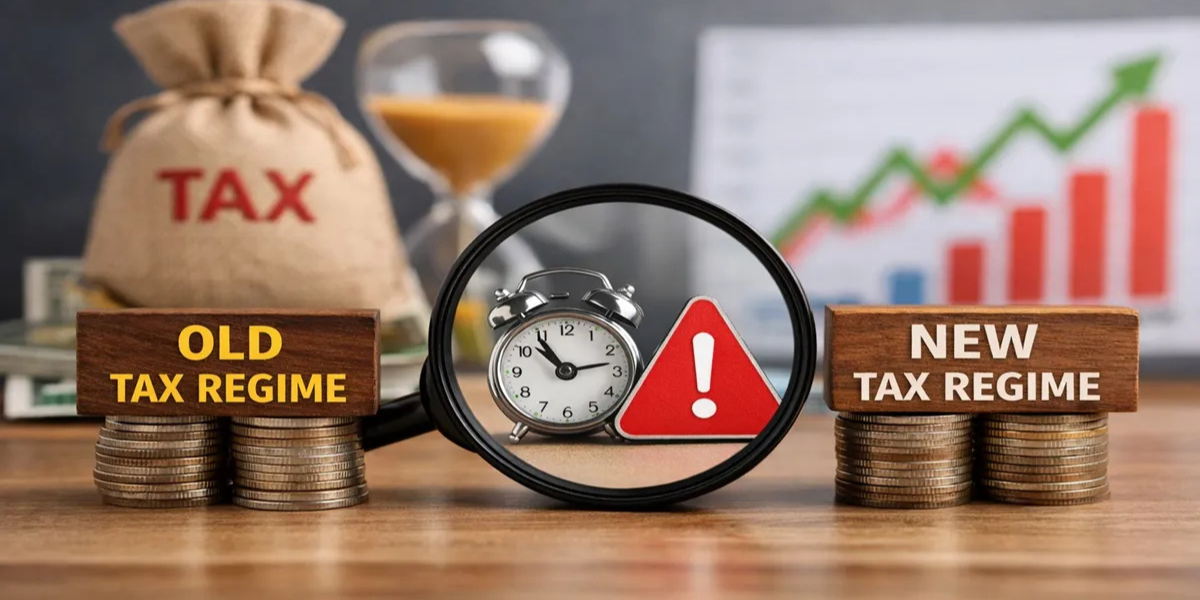
The Union Budget has reinforced India’s shift toward an uncomplicated tax structure, formalizing major steps under the updated income tax frameworks. For the Financial Year (FY) 2026-27 (Assessment Year 2027-28), the government has retained the existing tax slabs. The New Tax Regime remains the default choice for taxpayers, structured to lower the tax burden for the middle- and upper-middle-income brackets.
If you are trying to decide which regime will save you the most money this year, this breakdown outlines the structural differences, tax slabs, and calculation rules for FY 2026-27.
1. Comparing the Slabs: New vs. Old Regime
The New Tax Regime treats everyone equally regardless of age, while the Old Tax Regime maintains distinct slabs for senior citizens (ages 60–80) and super-senior citizens (ages 80+).
The New Tax Regime Slabs (Default)
The basic exemption limit stands at ₹4 Lakh.
| Income Bracket | Tax Rate |
| Up to ₹4,00,000 | NIL |
| ₹4,00,001 to ₹8,00,000 | 5% |
| ₹8,00,001 to ₹12,00,000 | 10% |
| ₹12,00,001 to ₹16,00,000 | 15% |
| ₹16,00,001 to ₹20,00,000 | 20% |
| ₹20,00,001 to ₹24,00,000 | 25% |
| Above ₹24,00,000 | 30% |
The Old Tax Regime Slabs (Optional)
The basic exemption limit stands at ₹2.5 Lakh for individuals under 60.
| Income Bracket | Tax Rate |
| Up to ₹2,50,000 | NIL |
| ₹2,50,001 to ₹5,00,000 | 5% |
| ₹5,00,001 to ₹10,00,000 | 20% |
| Above ₹10,00,000 | 30% |
Note on Old Regime Exemption: For Senior Citizens (60–80 years), income up to ₹3 Lakh is exempt. For Super Senior Citizens (80+ years), income up to ₹5 Lakh is exempt.
2. Key Differences: Deductions & Benefits
The structural trade-off between the two options forms the primary difference between the regimes. The Old Regime features higher baseline tax rates but lets you scale down your taxable income using investment-heavy deductions. The New Regime sacrifices those deductions in exchange for significantly lower slab rates.
| Feature | New Tax Regime | Old Tax Regime |
| Standard Deduction (Salaried) | ₹75,000 | ₹50,000 |
| Sec 87A Tax Rebate Limit | Income up to ₹12 Lakh | Income up to ₹5 Lakh |
| Max Sec 87A Rebate Amount | Up to ₹60,000 | Up to ₹12,500 |
| Sec 80C (PPF, ELSS, EPF, etc.) | Disallowed | Allowed up to ₹1.5 Lakh |
| Sec 80D (Health Insurance) | Disallowed | Allowed |
| House Rent Allowance (HRA) | Disallowed | Allowed |
| Home Loan Interest (Sec 24b) | Disallowed (Self-occupied) | Allowed up to ₹2 Lakh |
| Highest Surcharge Rate | 25% | 37% |
3. The Power of the New Regime: Zero Tax up to ₹12.75 Lakh
The core advantage of the New Tax Regime is the enhanced Section 87A rebate. If your net taxable income stays at or below ₹12 Lakh, your tax liability drops to zero. For a salaried individual, adding the ₹75,000 standard deduction creates an effective tax-free income threshold of ₹12.75 Lakh.
Case Study: Salaried Individual Earning ₹12,75,000
- Gross Salary: ₹12,75,000
- Less: Standard Deduction: ₹75,000
- Net Taxable Income: ₹12,00,000
Tax Calculation under New Slabs:
- Up to ₹4,00,000 = NIL
- ₹4,00,001 to ₹8,00,000 (5% of ₹4L) = ₹20,000
- ₹8,00,001 to ₹12,00,000 (10% of ₹4L) = ₹40,000
- Total Base Tax: ₹60,000
- Less: Section 87A Rebate: -₹60,000
- Final Tax Payable: ₹0
In comparison, an individual earning the same amount under the Old Regime without deductions would face a heavy tax bill exceeding ₹1.8 Lakh.
4. Which One Should You Choose?
The optimal choice depends on the scale of your investments and tax exemptions.
- Choose the New Tax Regime if: You prefer a simplified filing process without tracking investment lock-ins, or your gross salary falls below ₹12.75 Lakh. It also suits individuals who do not pay heavy home loan interest or high metro city house rents.
- Choose the Old Tax Regime if: You are aggressively making tax-saving investments. If you claim HRA, have a home loan on a self-occupied property (deducting ₹2 Lakh), max out Section 80C (₹1.5 Lakh), and pay for family health insurance (Section 80D), the Old Regime can still prove more cost-effective at higher income tiers.
The General Break-Even Rule
As a rule of thumb, for gross incomes above ₹15 Lakh, you generally need total deductions exceeding ₹3.75 Lakh to ₹4 Lakh under the Old Regime to match or beat the tax savings built into the New Regime’s lower tax rates.
Pro-Tip: Salaried individuals have the flexibility to switch between the Old and New regimes every financial year at the time of filing their Income Tax Return (ITR). Ensure you run your exact numbers through a tax calculator before finalizing your declaration.